


In the highly competitive world of online retail, your product images are the digital equivalent of a physical storefront window. When a customer lands on your store, they cannot touch, feel, or try on your products. Their entire purchasing decision relies on the visual information you provide. Because of this, mastering e-commerce product image optimization is no longer optional—it is the baseline for survival and growth. To find more, check on clippingpathwise.com
At the core of this visual perfection lies a technique that, while invisible to the customer, makes all the difference: the clipping path. Today, we are going to dive deep into how leveraging strategies—specifically being Clipping Path Wise—can transform your online store, boost your conversion rates, and streamline your entire digital operation.
Whether you are a solo entrepreneur shooting products in your garage or a massive retailer processing thousands of SKUs a month, understanding how to utilize clipping path services effectively will give you a significant edge in the e-commerce landscape.
The Foundation of E-commerce Visuals
Before we get into the technical mechanics, it is crucial to understand why image editing holds such power over consumer behavior. A shopper’s eye is naturally drawn to clarity and focus. If a product image is cluttered, poorly lit, or sitting on a distracting background, the perceived value of that product plummets.
Why Background Removal is Non-Negotiable
Have you ever noticed that almost every major online marketplace—from Amazon to eBay to Shopify’s top stores—requires products to be displayed on a pure white background? This is not a coincidence. Background removal serves several psychological and practical purposes:
- Zero Distractions: It forces the viewer’s eye directly onto the product.
- Consistency: It creates a uniform, professional grid on your category pages.
- Versatility: Once a background is removed, the isolated product can be placed into promotional banners, social media posts, or email campaigns.
To achieve this seamless look, e-commerce managers rely on specialized techniques. Let’s explore the most fundamental of these techniques and how it operates.
Demystifying the Clipping Path
To be Clipping Path Wise means understanding the exact tools and methods needed to flawlessly separate a product from its background. But what exactly is a clipping path?
A clipping path is a closed vector path or shape used to cut out a 2D image in image-editing software. Everything inside the path is included after the clipping path is applied, and everything outside the path is omitted. Think of it as using a highly precise digital pair of scissors to cut your product out of a magazine.
What is the Pen Tool Used For?
The magic behind a flawless clipping path is the Pen Tool. If you ask any seasoned graphic design professional, they will tell you that the Pen Tool is the most vital asset in their software arsenal. But what is the pen tool used for, exactly?
Unlike the Lasso tool or Magic Wand, which rely on the software’s automated (and often flawed) edge detection, the Pen Tool allows a human editor to manually draw paths using Bézier curves. By plotting “anchor points” along the edge of a product and manipulating the directional lines connecting them, an editor can create perfectly smooth, scalable curves that wrap tightly around a product’s silhouette. This guarantees precision that AI and automated tools still struggle to match, especially on complex items like jewelry or bicycles.
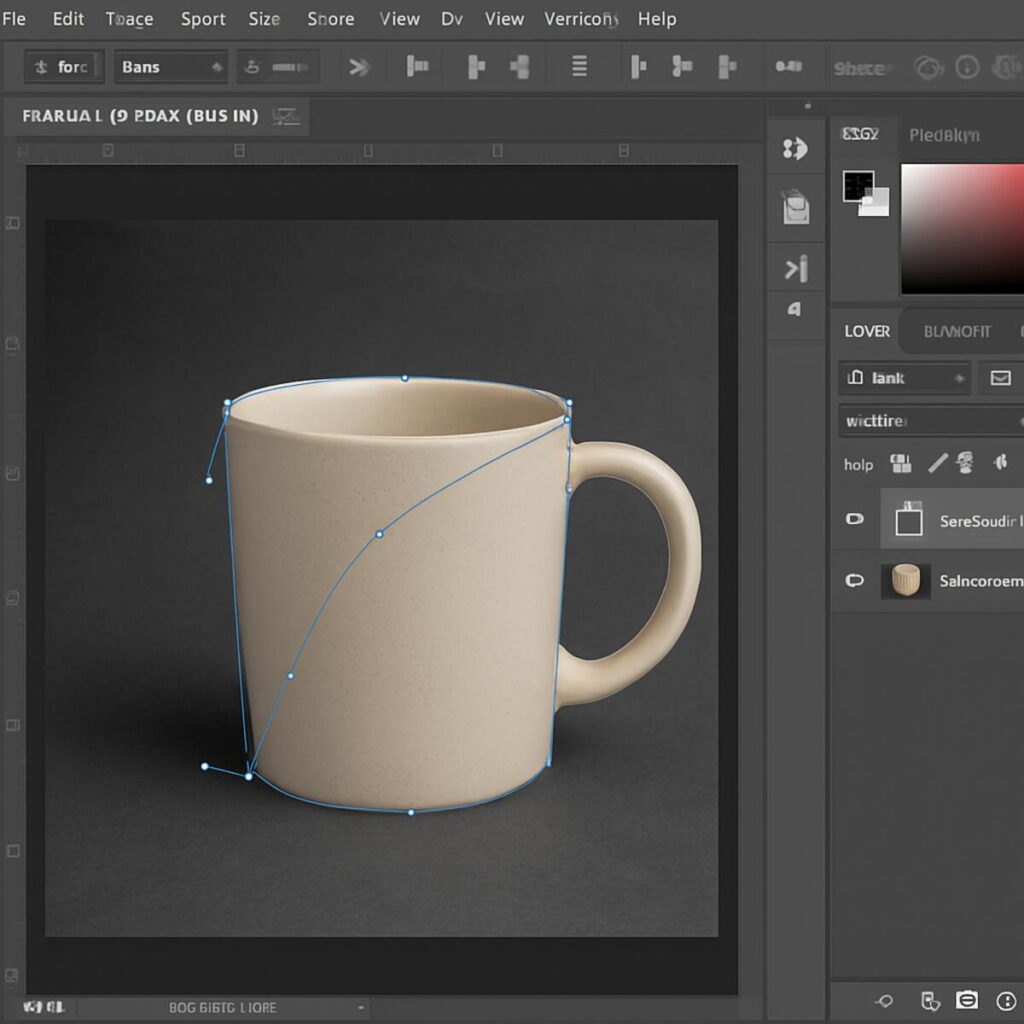
How to Create a Clipping Path in Photoshop
If you want to understand the meticulous nature of this work, it helps to know how the process works behind the scenes. Here is a brief, step-by-step look at how to create a clipping path in Photoshop:
- Open the Image: Load your raw product photo into Adobe Photoshop.
- Select the Pen Tool: Press ‘P’ on your keyboard to activate it. Ensure it is set to “Path” mode in the top options bar.
- Zoom In: A professional editor will zoom in to at least 200% or 300% to examine the exact pixels at the edges of the product.
- Plot Anchor Points: Click along the edge of the product to drop anchor points. Click and drag to create a curve that perfectly follows the item’s contour.
- Close the Path: Continue around the entire perimeter of the product until you reach the starting point, clicking on it to close the loop.
- Save the Path: Navigate to the Paths panel, double-click the “Work Path,” and name it (usually “Path 1”).
- Apply the Clipping Path: Select “Clipping Path” from the panel menu, set your flatness (usually to 0.5 or 1 for e-commerce), and save the file.
This process sounds simple in theory, but mastering the Pen Tool takes hundreds of hours of practice to ensure the cutouts don’t look jagged, blocky, or artificial.
Advanced Image Editing Decisions
Not every product is shaped like a perfectly smooth box or a round ball. E-commerce catalogs are diverse, meaning your editing techniques must be adaptable.
Clipping Path vs Image Masking
A common dilemma in e-commerce photo editing is choosing between clipping path vs image masking. Understanding the distinction is what separates an amateur store from a professional one.
- Clipping Path: Best used for products with hard, distinct edges. Think electronics, furniture, shoes, cosmetics, and packaged goods. The Pen Tool creates a hard, crisp boundary.
- Image Masking: Best used for products with soft, complex, or semi-transparent edges. Think models with flowing hair, fuzzy sweaters, teddy bears, or translucent glass bottles. A hard clipping path on a furry object will make it look as if it were cut out of plastic. Image masking uses advanced channel selection, background eraser tools, and refinement brushes to separate soft edges from the background while retaining fine details like individual strands of hair.
To be Clipping Path Wise is to know exactly which technique to apply to which product to yield the most natural result.
Multi Clipping Path for Color Correction
What happens when you have a product—say, a men’s button-down shirt—that comes in twelve different colors? Shooting the same shirt twelve times is expensive, time-consuming, and makes it incredibly difficult to keep the lighting and styling consistent across your catalog.
This is where a multi-clipping path for colour correction becomes a lifesaver.
A multi clipping path involves drawing several distinct paths within a single image. For the shirt example, an editor would draw one path for the main fabric, a separate path for the buttons, another path for the brand tag, and perhaps another for the inner collar.
Once these elements are isolated, the editor can selectively alter the color of the fabric without affecting the buttons or the tag. You can photograph the shirt once in a neutral color (like grey or white) and use non-destructive photo retouching techniques to generate the red, blue, green, and black variations digitally. This saves thousands of dollars in photography costs while ensuring visual consistency on your product pages.
Specialized Editing Services for E-commerce
Beyond standard background removal, there are several advanced techniques that top-tier e-commerce brands use to elevate their visual presentation. Let’s explore these essential clipping path services.
The Ghost Mannequin Effect for Apparel Photography
If you sell clothing online, you face a unique challenge: clothes look lifeless and flat when laid on a table, but hiring live models for every single SKU is incredibly expensive. Furthermore, models can sometimes distract the shopper from the actual garment.
The solution is the ghost mannequin effect for apparel photography (also known as the invisible mannequin technique). Here is how it works:
- The garment is photographed on a physical mannequin.
- The garment is removed, and the inner back area (the part the mannequin was blocking, such as the inside collar or inner tag) is photographed separately.
- An editor uses clipping paths to remove the physical mannequin from the first shot.
- The editor then composites the inner back area into the neck’s hollow space.
The final result is a 3D, hollow, perfectly structured garment that looks as though it is being worn by an invisible person. It gives shoppers a clear understanding of the clothing’s fit and drape, significantly boosting apparel conversion rates.
Fixing Low-Quality Product Images for the Web
Sometimes, despite your best efforts, the source photography isn’t perfect. Perhaps the lighting was too dim, causing digital noise, or the focus was slightly soft. Maybe you are dropshipping and have to rely on supplier photos that are lacklustre.
Fixing low-quality product images for the web is a critical service offered by professional retouching teams. Using non-destructive photo retouching techniques—such as adjustment layers, smart filters, and dodge/burn layers—an editor can rescue a poor photo without permanently destroying the original pixel data. This includes:
- Correcting white balance so your white products don’t look yellow.
- Sharpening edges so the product pops off the screen.
- Reducing grain and digital noise.
- Removing dust, scratches, and lint from the product itself.
Benefits of Using Vector Conversion Services
While we are largely discussing raster images (such as JPEGs and PNGs, which are pixel-based), we cannot ignore the importance of vector graphics in e-commerce. Sometimes, a product image features a printed logo, a decal, or typography that looks pixelated and blurry when zoomed in.
This is where you realize the benefits of using vector conversion services. A graphic design expert can manually trace a blurry, pixelated logo using the Pen Tool, converting it into a scalable vector graphic (SVG or EPS). This crisp, mathematically calculated vector can then be seamlessly composited back onto your product image, ensuring that when your customers hover over the image to zoom in, the branding looks impeccably sharp.
The Business Strategy of Photo Editing
Understanding the technical side of image editing is only half the battle. The other half is understanding how these processes fit into your broader business strategy. If you are handling a high volume of products, you cannot afford to have your marketing team or in-house photographers spending their valuable time digitally cutting out hundreds of images a day.
Why Hire a Professional Background Removal Service?
It is tempting to try to save money by using automated one-click AI background removal tools. While these tools have improved, they are still prone to critical errors. They frequently chop off the edges of white products shot on light backgrounds, struggle with reflections on metallic surfaces (like jewelry or watches), and leave ugly, jagged halos around complex shapes.
When a customer sees a poorly edited image with jagged edges, it subconsciously signals that the brand is cheap and untrustworthy. A professional background removal service guarantees pixel-perfect accuracy. Human editors have the contextual awareness to recognise that the silver reflection on a watch bezel is part of the watch, not the background—a distinction AI often fails to make.
Outsourcing High-Volume Photo Editing
As your e-commerce store grows, your visual content needs will skyrocket. Preparing for a seasonal catalog launch or a Black Friday sale might require processing thousands of images in a matter of days. This is the exact moment when outsourcing high-volume photo editing becomes a strategic necessity.
By partnering with top-rated offshore image retouching agencies, you gain access to an army of highly skilled editors who work while you sleep. You can upload a batch of raw files at the end of your workday and wake up to beautifully clipped, color-corrected, and web-ready images the next morning.
This creates a seamless, rapid workflow that allows your core team to focus on what actually grows the business: marketing, customer service, and product development.
Evaluating the Cost of Bulk Image Background Removal
A common concern for business owners is pricing. What is the actual cost of bulk image background removal? The truth is, outsourcing is vastly more cost-effective than hiring in-house editors.
Most offshore agencies price their services based on the complexity of the image:
- Simple Complexity: Objects with straight lines and simple curves (e.g., a smartphone or a book). These can cost as little as $0.25 to $0.50 per image.
- Medium Complexity: Objects with multiple curves and holes (e.g., a pair of shoes, a handbag). These typically range from $0.75 to $1.50 per image.
- High/Super Complex: Objects with incredibly intricate details, numerous cutouts, or requiring masking (e.g., a bicycle with wire spokes, a complex piece of jewelry, or a model with flowing hair). These might cost anywhere from $2.00 to $5.00+ per image.
When you factor in the time saved and the increased conversion rates generated by flawless imagery, the ROI on these services is incredibly high.
Ensuring Quality and Web Performance
If you decide to outsource your image editing to be more Clipping Path Wise, you need to know how to manage your vendor and ensure the output meets your standards. Furthermore, once you receive the images, you must ensure they perform well on your website.
How to Evaluate Photo Editing Quality Standards
When you receive a batch of edited images from a clipping path service, do not just glance at the thumbnails and approve them. You must establish a strict Quality Assurance (QA) process. Here is how to evaluate photo editing quality standards:
- The 300% Zoom Test: Open the image in Photoshop or a high-quality viewer and zoom in to 300% on the edges of the product. Are the edges smooth? If they look like a staircase (stair-stepping or jagged), the editor rushed the Pen Tool process.
- Check for “Halos”: Look closely at the boundary where the product meets the white background. Do you see a thin line of the original background color (grey, blue, etc.) lingering on the edge? This is known as a halo and signifies an inaccurate clipping path.
- Inspect the Cutouts: Did the editor remember to clip out the background inside the product? For example, the space inside the handle of a coffee mug or the space between a model’s arm and torso.
- Shadow Authenticity: If you requested a drop shadow or natural shadow, does it look realistic? A shadow that is too dark, too sharp, or pointing in the wrong direction relative to the product’s highlights will make the image look like a cheap composite.
Improving Website Loading Speed with Optimized Images
You finally have a batch of stunning, perfectly clipped, high-resolution product photos. But there is a catch: if you upload massive 5MB image files directly to your Shopify or WooCommerce store, your website will slow to a crawl.
In today’s digital landscape, a slow website kills sales. Studies consistently show that if a page takes longer than three seconds to load, over 50% of mobile users will abandon the site. Furthermore, Google uses page speed as a major ranking factor in its search algorithms.
This is why improving website loading speed with optimized images is the crucial final step of the e-commerce image pipeline.
- Resizing: Never upload an image larger than necessary. For most e-commerce platforms, a maximum dimension of 2000×2000 pixels is more than enough to allow for a high-quality zoom feature without bloating the file size.
- Format Selection:
- Use JPEG for standard product images on solid backgrounds. It offers the best balance of quality and compression.
- Use PNG only when you need a transparent background (for instance, if your website has a coloured background rather than white). Note that PNG files are significantly larger.
- Consider WebP: This modern image format provides superior lossless and lossy compression for images on the web. WebP lossless images are 26% smaller than PNGs.
- Compression: Run all your images through a compression tool (lossy or lossless, like TinyPNG or ImageOptim) before uploading. A good clipping path agency will actually do this step for you if you include it in your project brief, delivering perfectly compressed, web-ready files.
Integrating Graphic Design with Clipping Paths
To truly maximize your e-commerce success, you must view your product images not just as standalone catalog items, but as versatile assets. Once an item has been liberated from its background via a professional clipping path, it enters the realm of graphic design.
Think about your homepage banners, your Facebook ad creatives, and your email marketing graphics. These assets require dynamic compositions. A skilled graphic designer can take your clipped product images and:
- Place them in imaginative lifestyle composites.
- Arrange them in engaging flat-lay layouts.
- Add dynamic typography and branded color palettes behind them.
- Create visual depth using reflection shadows and 3D placement.
By maintaining a unified workflow in which your clipping path services feed directly into your graphic design pipeline, you create a cohesive, visually arresting brand identity that sets you apart from amateur competitors.
Best Practices for a Seamless Workflow
If you are ready to implement these strategies and elevate your e-commerce imagery, establishing a smooth workflow is essential. Here are some actionable tips for managing your image optimization pipeline:
- Create a Standard Operating Procedure (SOP) for Photography to Ensure your in-house or freelance photographers use a consistent setup. Consistent lighting and framing make the clipping path process faster and cheaper.
- Write a Detailed Brief for Your Retouchers: Don’t just say “remove background.” Specify exactly what you need. E.g., “Create a hand-drawn clipping path. Provide a pure white background (Hex #FFFFFF). Add a natural drop shadow at 15% opacity. Resize to 1500x1500px, 72 DPI, and compress as a JPEG.”
- Organize Your Files: Use a strict naming convention for your SKUs. If you are sending 500 images to an offshore agency, disorganized files will result in chaos. Name your files consistently (e.g., Brand_Category_SKU_Front.jpg).
- Request a Trial: Before committing to a massive contract with any retouching agency, ask for a free trial. Send them 3 to 5 complex images and evaluate their output against the quality standards we discussed earlier.
The Long-Term Value of Impeccable Imagery
It is easy to look at image editing as just another tedious administrative task on your e-commerce to-do list. However, shifting your mindset to view it as a core sales driver changes everything.
When you invest in professional background removal service and advanced non-destructive photo retouching techniques, you are directly investing in consumer trust. A shopper who sees a crisp, perfectly lit, multi-angled product presentation feels confident. They feel that if a brand cares this much about its digital presentation, it likely cares about the quality of the physical product and its customer service as well.
Conversely, ignoring these standards leads to high bounce rates, increased product returns (because the product didn’t look like the photo), and ultimately, a failing business model.
Conclusion
Succeeding in e-commerce is a game of marginal gains. Every fraction of a second you shave off your page load time by improving website loading speed with optimised images. Every percentage point you increase your conversion rate by utilizing the ghost mannequin effect for apparel photography matters.
Being Clipping Path Wise means understanding the profound impact that high-quality, precise image editing has on your bottom line. From knowing what is the pen tool used for to effectively outsourcing high-volume photo editing, mastering the visual pipeline is the key to scaling your store.
Don’t let subpar images hold your fantastic products back. Partner with top-rated offshore image retouching agencies, demand pixel-perfect clipping paths, and watch as your professional, distraction-free imagery turns casual browsers into lifelong, loyal customers.
